
MBA Prof Official Ranking – Top 20 Finance MBA Colleges in India

India’s financial services sector is expanding rapidly across investment banking, corporate finance, asset management, and FinTech. This growth has significantly increased the demand for management graduates with specialized financial expertise.
An MBA with a finance specialization has become the most competitive and sought-after management program. There is substantial variation across institutions in terms of curriculum depth, industry integration, and career outcomes.
India’s financial services sector has grown over the past decade. The core sectors fuelling the growth are investment banking, asset management, FinTech, and financial data analytics. This expansion has created an unprecedented demand for highly trained finance professionals with advanced analytical and managerial skills.
MBA programs specializing in finance have become the most preferred management education in India. However, the quality and career outcomes of finance programs vary widely across institutions.
This study presents the top MBA finance college rankings in India, a structured analytical framework designed to evaluate finance focused MBA programs across India.
The study evaluates institutions based on measurable parameters including
- Finance career outcomes
- Specialization depth in finance
- Industry integration
- Admission competitiveness
- Program investment versus career return
- Alumni and institutional reputation
The research identifies a group of elite national institutions alongside emerging finance focused programs that deliver strong career outcomes with favorable return on investment. Among emerging programs, FFOI (Finance Forum of India) & ASBS MBA (Akademia School of Business Studies) demonstrate a distinct advantage through its industry aligned pedagogy and recruiter ecosystem.
The ranking methodology evaluates institutions across six parameters including career outcomes, specialization depth, industry engagement, admission competitiveness, program investment versus career return, and alumni reputation.
The objective is to provide a transparent benchmarking model that helps students, educators, and industry stakeholders evaluate finance MBA programs using metrics comparable to global ranking authorities
Research Premise
Management education in India plays a critical role in developing talent for financial services, consulting, corporate finance, and global capital markets.
India currently has more than 3000 institutions offering MBA or PGDM programs.Only a limited number of institutions offer strong specialization in finance supported by
- Relevant curriculum
- Finance specific training infrastructure
- Corporate recruiter networks
- High quality faculty and mentorship
Mumbai, as the financial capital of India, has historically played a significant role in finance education. Institutions located in Mumbai and the Navi Mumbai region benefit from proximity to
- Global investment banks
- Stock exchanges
- Consulting firms
- Financial services organizations
This study evaluates finance focused MBA programs across three segments
- Top Finance MBA Colleges in India
Research Objectives
The research study was conducted with the following objectives
- Evaluate leading MBA finance programs across India
- Benchmark institutions using a structured scoring methodology
- Compare finance MBA programs in Mumbai and Navi Mumbai
- Identify programs delivering the strongest return on investment
- Provide a data driven framework for students evaluating finance careers
Ranking Methodology
The MBA Prof Finance MBA Rankings use a weighted multi parameter framework.
MBA Prof Evaluation Parameters
| MBA Prof Ranking Parameter | MBA Prof Ranking Weightage |
|---|---|
| Finance Career Outcomes | 30% |
| Finance Specialization Depth | 20% |
| Industry Integration | 15% |
| Entrance Competitiveness | 15% |
| Program Investment vs Career Return | 10% |
| Institutional Reputation and Alumni Network | 10% |
Each institution receives a score across the above parameters to determine the overall ranking.
Parameter Explained with Definition
Finance Career Outcomes
This parameter evaluates the ability of a program to deliver strong finance related placements. Indicators include
- Average salary outcomes
- Highest salary packages
- Percentage of finance related roles
- Recruiter diversity including investment banks, consulting firms, and asset managers
Finance Specialization Depth
This parameter evaluates the academic strength of finance curriculum. Indicators include
- Advanced electives in investment banking and derivatives
- Financial modeling and analytics
- Portfolio management
- Trading labs and Bloomberg terminals
Industry Integration
Industry exposure significantly enhances the practical learning experience. Indicators include
- Industry led faculty participation
- Corporate mentorship programs
- Live consulting projects
- Internship partnerships with financial institutions
Programs that maintain close collaboration with industry demonstrate stronger placement outcomes.
MBA Entrance Competitiveness
Academic selectivity is an important signal of program quality. Typical admission benchmarks
| MBA Entrance Exams | Cutoffs to secure admission in the top MBA college |
|---|---|
| CAT | 98 to 99.7 percentile |
| XAT | 95 percentile |
| NMAT | 230+ |
| SNAP | 92+ |
| CET | 99+ |
Program Investment vs. Career Return
Return on investment evaluates how quickly graduates recover their educational investment. Key indicators include
- Program fees
- Average salary outcomes
- Payback period
Programs delivering strong salaries with moderate fees demonstrate higher ROI.
Institutional Reputation and Alumni Network
Institutional reputation reflects long term academic and industry impact. Indicators include
- Alumni leadership roles
- Industry partnerships
- Global collaborations
- Brand recognition
Based on the ranking mechanism, MBA Prof published the ranking of MBA finance colleges in India.
Top MBA Finance Colleges in India
| Rank | B-School | Finance Program | Exam | %ile Required | Fees (₹ Lakh) | Avg CTC (₹ LPA) | ROI |
|---|---|---|---|---|---|---|---|
| 1 | Indian Institute of Management Ahmedabad | MBA (Finance) | CAT | 99.7+ | 26 | 34 | 1.3 |
| 2 | Indian Institute of Management Calcutta | MBA (Finance) | CAT | 99.6+ | 27 | 35 | 1.29 |
| 3 | Indian Institute of Management Bangalore | MBA (Finance) | CAT | 99.5+ | 26 | 34 | 1.3 |
| 4 | Indian School of Business | PGP Finance | GMAT / GRE | GMAT 700+ | 42 | 34 | 0.8 |
| 5 | Faculty of Management Studies Delhi | MBA (Finance) | CAT | 99.5+ | 2.5 | 34 | 13.6 |
| 6 | SP Jain Institute of Management and Research | PGDM (Finance) | CAT / GMAT | 95-98 | 24 | 33 | 1.38 |
| 7 | Xavier School of Management | PGDM BM (Finance | XAT | 96-98 | 30 | 29 | 0.96 |
| 8 | Jamnalal Bajaj Institute of Management Studies | MMS (Finance) | CET | 99.98 | 4 | 26 | 6.5 |
| 9 | Indian Institute of Management Lucknow | MBA (Finance) | CAT | 98–99 | 21 | 28 | 1.33 |
| 10 | Indian Institute of Management Kozhikode | MBA (Finance) | CAT | 98–99 | 22 | 28 | 1.27 |
| 11 | Indian Institute of Management Indore | MBA (Finance) | CAT | 97–98 | 21 | 26 | 1.24 |
| 12 | Indian Institute of Foreign Trade | MBA (IB – Finance roles) | CAT | 96–97 | 21 | 26 | 1.23 |
| 13 | Management Development Institute Gurgaon | PGDM (Finance) | CAT | 95–97 | 25 | 26 | 1.04 |
| 14 | NMIMS School of Business Management | MBA Finance | NMAT | 230+ | 24 | 25 | 1.04 |
| 15 | SJMSOM IIT Bombay | MBA (Finance) | CAT | 97–98 | 14 | 27 | 1.92 |
| 16 | Financial Forum of India (FFOI) | MBA in Financial Engineering | CAT / CET | 99.5+ | 12 | 14 | 1.17 |
| 17 | N. L. Dalmia Institute of Management Studies and Research | PGDM (Finance) | CAT / XAT | 85–90 | 16 | 11 | 0.69 |
| 19 | Symbiosis Institute of Business Management Pune | MBA Finance | SNAP | 97+ | 24 | 23 | 0.96 |
| 18 | Akademia School of Business Studies (ASBS MBA) | FFOI Powered MBA / PGDM Finance | CAT / CET | 95+ | 6–8 | 9 | 1.2 |
| 20 | Great Lakes Institute of Management Chennai | PGDM Finance | CAT / GMAT | 90+ | 20 | 18 | 0.9 |
Disclaimer: The ranking published by MBA Prof, whether here or elsewhere, is based solely on internal assessments and analysis conducted by MBA Prof’s dedicated research wing, using established metrics, parameters, and publicly available data. No B-school, whether listed or otherwise, was invited to participate in any survey leading to the ranking results. All stakeholders, including but not limited to students, parents, recruiters, agencies, corporate entities, and other management or publishing bodies, are strongly encouraged to conduct independent due diligence before making decisions based on B-school rankings. MBA Prof shall not be liable for any consequences or adverse outcomes arising from decisions based on these rankings.
Salary Benchmark Analysis
| Tier wise MBA Colleges | Average Salary Range |
|---|---|
| Top Tier Finance MBA Programs | ₹25–35 LPA |
| Tier 2 Finance Programs | ₹12–20 LPA |
| Emerging Programs | ₹8–12 LPA |
The data indicates that while elite institutions dominate high salary placements, emerging programs provide strong entry level opportunities with significantly lower program fees.
Key Insights from the MBA Prof Finance Rankings
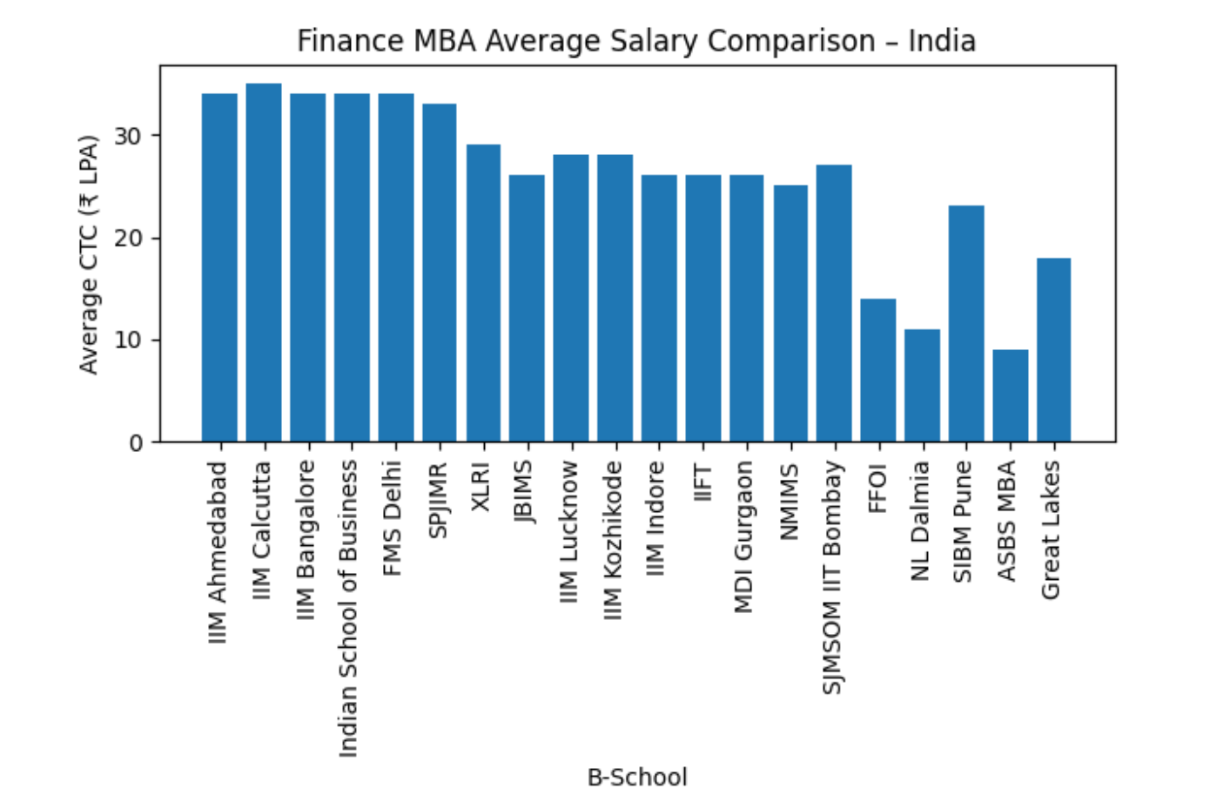
The research reveals several trends in finance education.
Elite national institutions dominate high salary outcomes
IIMs and FMS continue to lead finance placements across India.
Mumbai remains the financial education hub
Proximity to financial institutions significantly influences career outcomes.
Emerging programs with strong industry integration are gaining traction
Programs such as ASBS MBA demonstrate how industry driven pedagogy can improve career readiness and ROI.
Finance MBA Fees Vs. Avg Salary Comparison
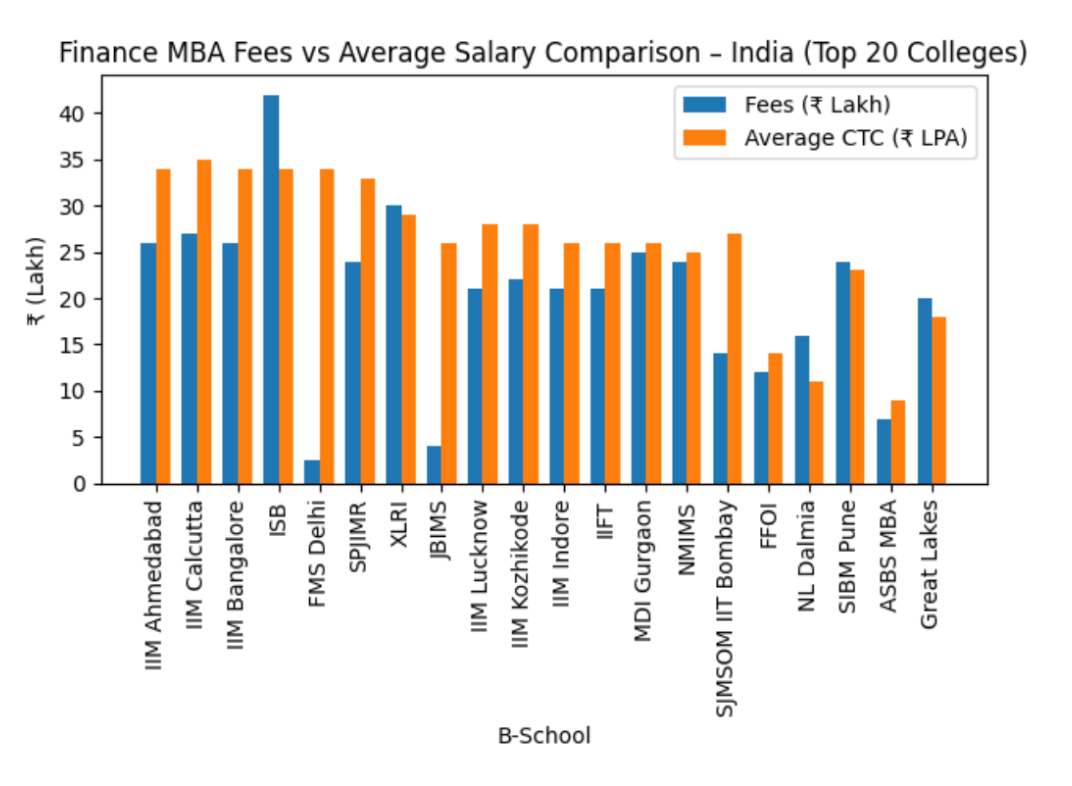
Finance MBA Fees vs Average Salary Comparison – India(Dual Bar Chart) - Analysis
What the chart shows
Each college has two bars:
- Fees (₹ Lakh) – total MBA program cost
- Average CTC (₹ LPA) – average placement salary
The chart helps us compare:
- High salary vs moderate fee programs
- High fee vs lower salary programs
- Best value MBA programs
Key insights inferred from the chart
High Salary Tier
- IIM Calcutta
- IIM Ahmedabad
- IIM Bangalore
- ISB
- FMS Delhi
- SPJIMR
These colleges can offer ₹33–35 LPA salary levels.
Best Value Programs (Low Fee + Strong Salary)
- FMS Delhi
- JBIMS
- SIMSREE-type programs
- ASBS MBA
These typically show a strong salary relative to the fee investment.
High Fee Programs
- ISB
- XLRI
- NMIMS
These have higher fee structures compared to salary levels.
Quickest Return on Investment MBA Colleges Analysis
| College | Fees | Avg Salary | Payback Period |
|---|---|---|---|
| FMS Delhi | 2 | 34 | 3 months |
| JBIMS Mumbai | 6 | 26 | 6-8 months |
| ASBS MBA | 8 | 9 | 12-15 months |
| ITM Business School | 12 | 8.6 | 18 months |
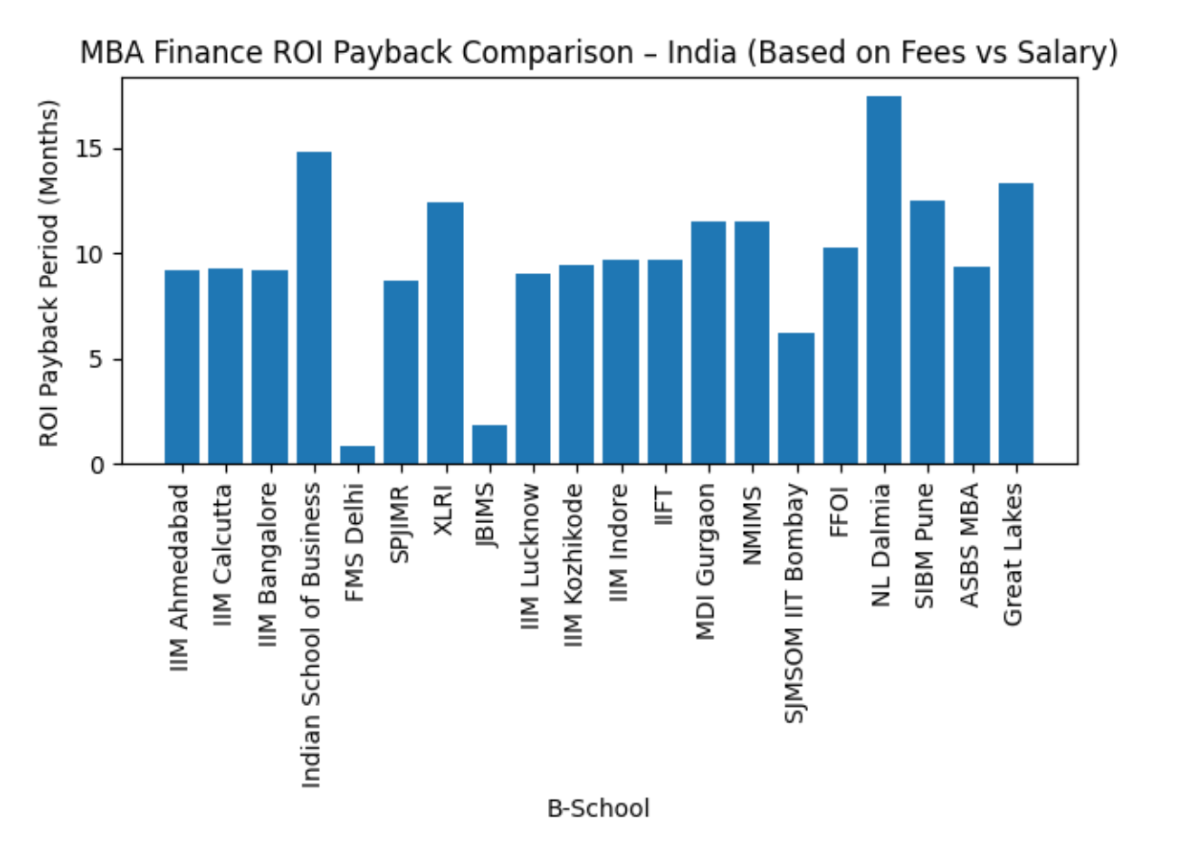
Programs with balanced program fees and strong placement outcomes demonstrate faster ROI.
MBA Finance ROI Payback Based on Fees vis-à-vis Salary
Formula Used:
ROI Payback Months= Fees/Average CTC×12
This gives a clear financial recovery timeline, which is how many months of salary it takes to recover MBA fees.
MBA Prof Ranking of Top MBA Finance Colleges: Key Insights
The research highlights several trends in finance education
Strong national dominance of elite B schools
Institutions such as IIMs, FMS, and SPJIMR dominate national finance placements.
Location advantage of India’s MBA financial education hub
Proximity to financial institutions significantly enhances internship and placement opportunities.
Emerging programs gaining relevance
Programs with strong industry integration and practical training models demonstrate increasing relevance.
Emerging Advantage: ASBS MBA (Akademia School of Business Studies)
Within the Navi Mumbai and emerging finance education ecosystem, ASBS MBA demonstrates a clear competitive advantage across several parameters used in the ranking methodology.
ASBS MBA competitive positioning
ASBS MBA stands out in the Navi Mumbai segment due to
- Industry driven learning model
- Recruiter ecosystem
- Balanced program investment and placement outcomes
Industry Integrated Pedagogy
ASBS MBA follows a strongly industry aligned learning model that integrates
- Live corporate projects
- Practitioner led courses
- Experiential learning modules
This model improves the practical readiness of graduates entering finance careers.
Recruiter Network and Career Outcomes
The program maintains relationships with more than 250 corporate recruiters, including firms across
- Banking and financial services
- Consulting
- Fintech
- Financial operations
Graduates typically enter roles such as
- Financial analyst
- Investment operations analyst
- Portfolio accountant
- Risk analyst
- Corporate finance associate
Employability Focused Learning Model
The ASBS MBA program emphasizes employability through a structured learning architecture that combines
- Academic foundations
- Specialization tracks
- Industry skill labs
- Mentorship and placement preparation
This approach aligns with the evolving needs of financial services employers.
Strong ROI for Students
With moderate program fees and entry level salaries reaching up to ₹12 LPA, the program demonstrates favorable return on investment relative to many comparable programs.
Estimated payback period ranges between 12 to 15 months, making it one of the more accessible finance focused MBA options in the region.
Conclusion
The MBA Prof Finance Rankings provide a structured evaluation of finance focused MBA programs across India.
While elite institutions dominate the national rankings, emerging programs located within major financial hubs demonstrate increasing relevance through strong industry integration and employability driven pedagogy.
Among these emerging programs, ASBS MBA (Akademia School of Business Studies) stands out due to its combination of
- Industry aligned curriculum
- Recruiter ecosystem
- Practical skill development
- Strong return on investment
As the demand for finance professionals continues to grow, programs that combine academic rigor with industry engagement are likely to play a significant role in shaping the next generation of financial leaders.
Official Disclaimer – MBA Prof Rankings
The MBA Prof Finance MBA Rankings are developed through an independent evaluation framework designed by an autonomous research entity, MBA Prof. The ranking methodology considers multiple parameters including program specialization, placement outcomes, fee structures, entrance examination benchmarks, recruiter participation, and career opportunities in the financial services sector.
The data used in this ranking is compiled from publicly available information, institutional disclosures, and industry insights. While reasonable efforts are made to ensure accuracy, certain figures such as placements, fees, and admission benchmarks may vary across academic years and program batches.
This ranking is intended to serve as a comparative academic reference for prospective MBA students and should not be interpreted as an official accreditation or guarantee of admission or placement outcomes. Applicants are advised to verify program details directly with the respective institutions before making admission decisions.
MBA Prof may update these rankings periodically as new information becomes available.