

India’s financial services sector is expanding rapidly across investment banking, corporate finance, asset management, and FinTech. This growth has significantly increased the demand for management graduates with specialized financial expertise.
An MBA with a finance specialization has become the most competitive and sought-after management program. There is substantial variation across institutions in terms of curriculum depth, industry integration, and career outcomes.
India’s financial services sector has grown over the past decade. The core sectors fuelling the growth are investment banking, asset management, FinTech, and financial data analytics. This expansion has created an unprecedented demand for highly trained finance professionals with advanced analytical and managerial skills.
MBA programs specializing in finance have become the most preferred management education in India. However, the quality and career outcomes of finance programs vary widely across institutions.
This study presents the top MBA finance college rankings in India, a structured analytical framework designed to evaluate finance focused MBA programs across India.
The study evaluates institutions based on measurable parameters including
The research identifies a group of elite national institutions alongside emerging finance focused programs that deliver strong career outcomes with favorable return on investment. Among emerging programs, FFOI (Finance Forum of India) & ASBS MBA (Akademia School of Business Studies) demonstrate a distinct advantage through its industry aligned pedagogy and recruiter ecosystem.
The ranking methodology evaluates institutions across six parameters including career outcomes, specialization depth, industry engagement, admission competitiveness, program investment versus career return, and alumni reputation.
The objective is to provide a transparent benchmarking model that helps students, educators, and industry stakeholders evaluate finance MBA programs using metrics comparable to global ranking authorities
| MBA Prof Ranking Parameter | MBA Prof Ranking Weightage |
|---|---|
| Finance Career Outcomes | 30% |
| Finance Specialization Depth | 20% |
| Industry Integration | 15% |
| Entrance Competitiveness | 15% |
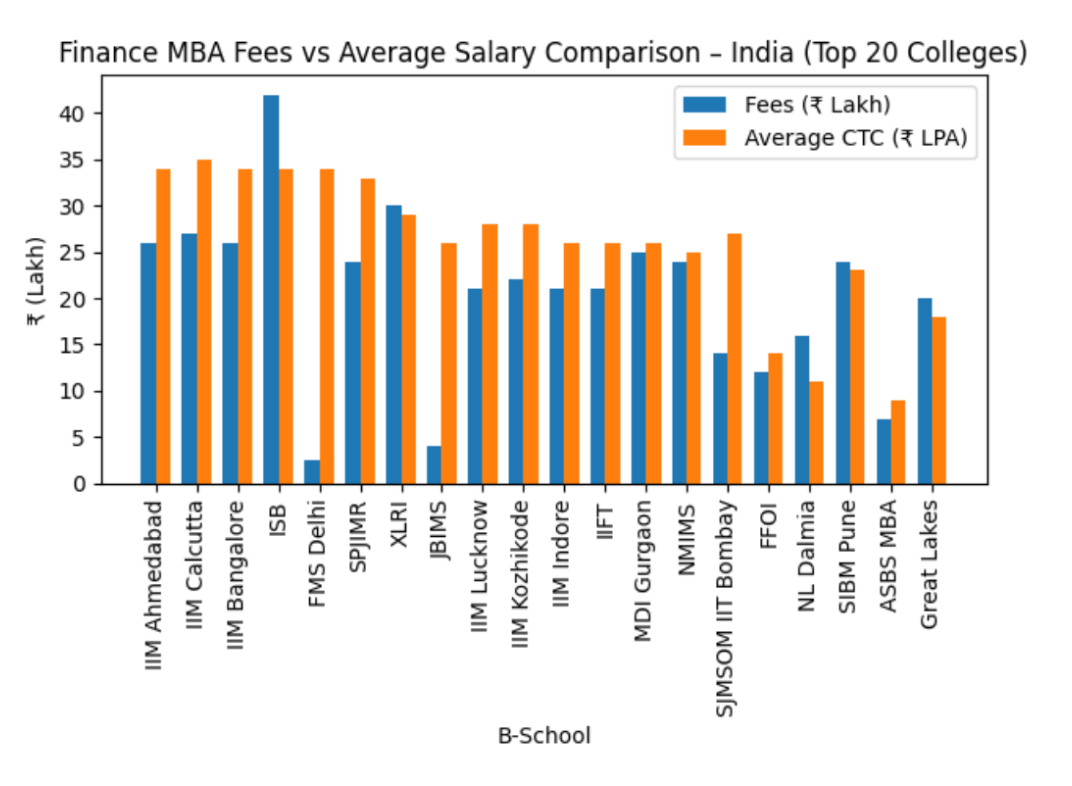
| Program Investment vs Career Return | 10% |
| Institutional Reputation and Alumni Network | 10% |
| MBA Entrance Exams | Cutoffs to secure admission in the top MBA college |
|---|---|
| CAT | 98 to 99.7 percentile |
| XAT | 95 percentile |
| NMAT | 230+ |
| SNAP | 92+ |
| CET | 99+ |
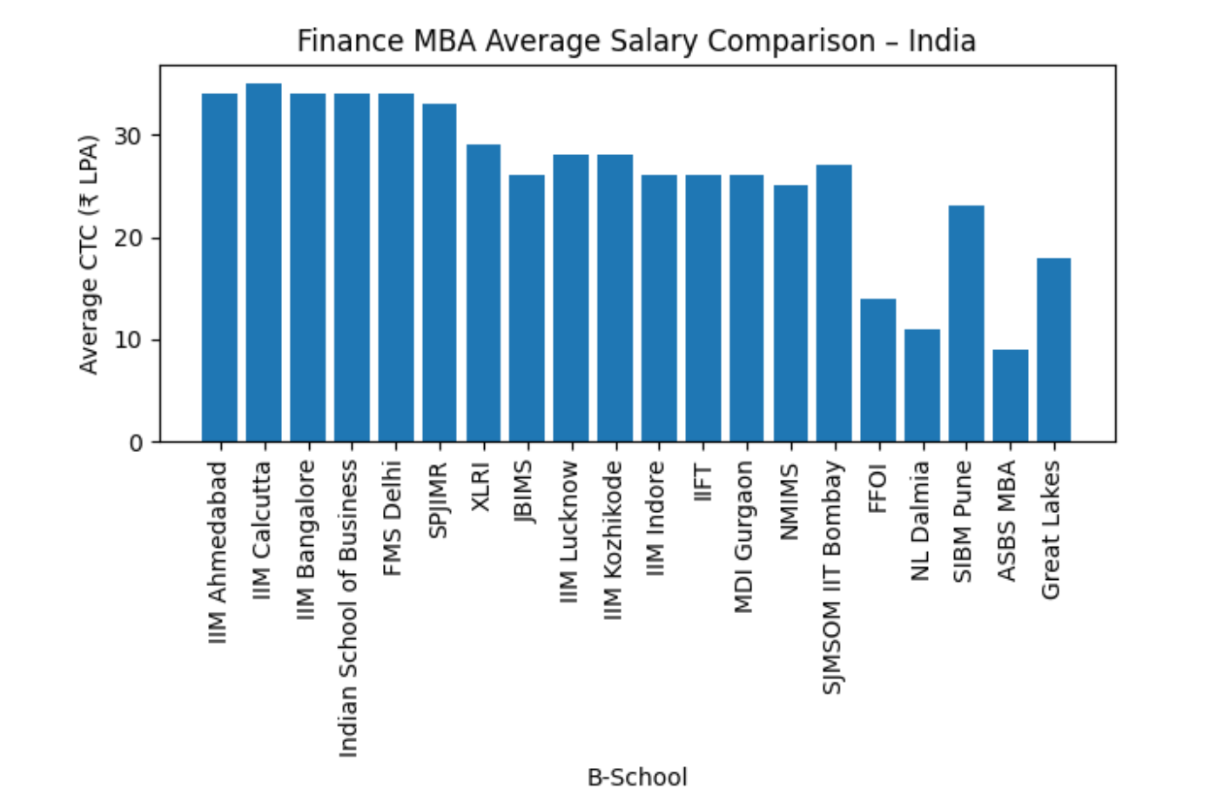
| Rank | B-School | Finance Program | Exam | %ile Required | Fees (₹ Lakh) | Avg CTC (₹ LPA) | ROI |
|---|---|---|---|---|---|---|---|
| 1 | Indian Institute of Management Ahmedabad | MBA (Finance) | CAT | 99.7+ | 26 | 34 | 1.3 |
| 2 | Indian Institute of Management Calcutta | MBA (Finance) | CAT | 99.6+ | 27 | 35 | 1.29 |
| 3 | Indian Institute of Management Bangalore | MBA (Finance) | CAT | 99.5+ | 26 | 34 | 1.3 |
| 4 | Indian School of Business | PGP Finance | GMAT / GRE | GMAT 700+ | 42 | 34 | 0.8 |
| 5 | Faculty of Management Studies Delhi | MBA (Finance) | CAT | 99.5+ | 2.5 | 34 | 13.6 |
| 6 | SP Jain Institute of Management and Research | PGDM (Finance) | CAT / GMAT | 95-98 | 24 | 33 | 1.38 |
| 7 | Xavier School of Management | PGDM BM (Finance | XAT | 96-98 | 30 | 29 | 0.96 |
| 8 | Jamnalal Bajaj Institute of Management Studies | MMS (Finance) | CET | 99.98 | 4 | 26 | 6.5 |
| 9 | Indian Institute of Management Lucknow | MBA (Finance) | CAT | 98–99 | 21 | 28 | 1.33 |
| 10 | Indian Institute of Management Kozhikode | MBA (Finance) | CAT | 98–99 | 22 | 28 | 1.27 |
| 11 | Indian Institute of Management Indore | MBA (Finance) | CAT | 97–98 | 21 | 26 | 1.24 |
| 12 | Indian Institute of Foreign Trade | MBA (IB – Finance roles) | CAT | 96–97 | 21 | 26 | 1.23 |
| 13 | Management Development Institute Gurgaon | PGDM (Finance) | CAT | 95–97 | 25 | 26 | 1.04 |
| 14 | NMIMS School of Business Management | MBA Finance | NMAT | 230+ | 24 | 25 | 1.04 |
| 15 | SJMSOM IIT Bombay | MBA (Finance) | CAT | 97–98 | 14 | 27 | 1.92 |
| 16 | Financial Forum of India (FFOI) | MBA in Financial Engineering | CAT / CET | 99.5+ | 12 | 14 | 1.17 |
| 17 | N. L. Dalmia Institute of Management Studies and Research | PGDM (Finance) | CAT / XAT | 85–90 | 16 | 11 | 0.69 |
| 19 | Symbiosis Institute of Business Management Pune | MBA Finance | SNAP | 97+ | 24 | 23 | 0.96 |
| 18 | Akademia School of Business Studies (ASBS MBA) | FFOI Powered MBA / PGDM Finance | CAT / CET | 95+ | 6–8 | 9 | 1.2 |
| 20 | Great Lakes Institute of Management Chennai | PGDM Finance | CAT / GMAT | 90+ | 20 | 18 | 0.9 |
Disclaimer: The ranking published by MBA Prof, whether here or elsewhere, is based solely on internal assessments and analysis conducted by MBA Prof’s dedicated research wing, using established metrics, parameters, and publicly available data. No B-school, whether listed or otherwise, was invited to participate in any survey leading to the ranking results. All stakeholders, including but not limited to students, parents, recruiters, agencies, corporate entities, and other management or publishing bodies, are strongly encouraged to conduct independent due diligence before making decisions based on B-school rankings. MBA Prof shall not be liable for any consequences or adverse outcomes arising from decisions based on these rankings.
| Tier wise MBA Colleges | Average Salary Range |
|---|---|
| Top Tier Finance MBA Programs | ₹25–35 LPA |
| Tier 2 Finance Programs | ₹12–20 LPA |
| Emerging Programs | ₹8–12 LPA |
| College | Fees | Avg Salary | Payback Period |
|---|---|---|---|
| FMS Delhi | 2 | 34 | 3 months |
| JBIMS Mumbai | 6 | 26 | 6-8 months |
| ASBS MBA | 8 | 9 | 12-15 months |
| ITM Business School | 12 | 8.6 | 18 months |
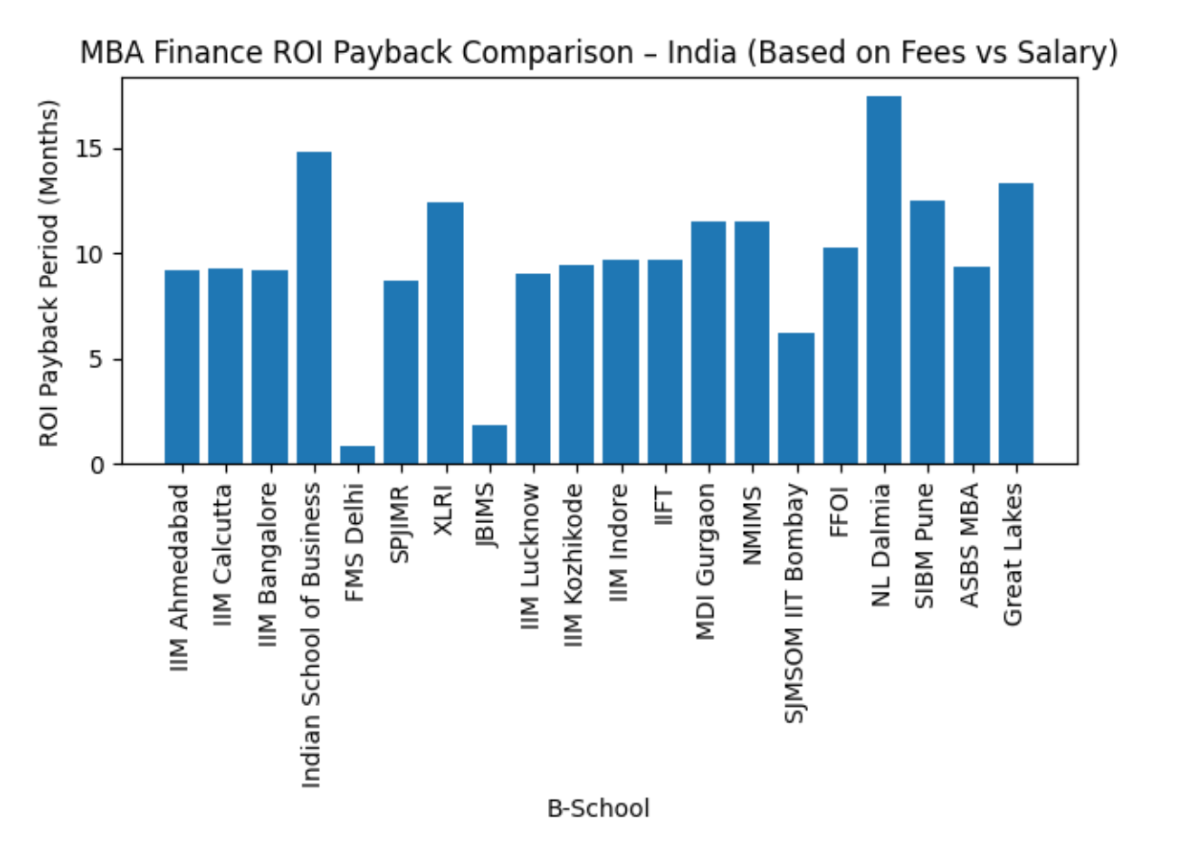
Formula Used:
ROI Payback Months= Fees/Average CTC×12
This gives a clear financial recovery timeline, which is how many months of salary it takes to recover MBA fees.
Within the Navi Mumbai and emerging finance education ecosystem, ASBS MBA demonstrates a clear competitive advantage across several parameters used in the ranking methodology.
This model improves the practical readiness of graduates entering finance careers.
The program maintains relationships with more than 250 corporate recruiters, including firms across
With moderate program fees and entry level salaries reaching up to ₹12 LPA, the program demonstrates favorable return on investment relative to many comparable programs.
Estimated payback period ranges between 12 to 15 months, making it one of the more accessible finance focused MBA options in the region.
The MBA Prof Finance Rankings provide a structured evaluation of finance focused MBA programs across India.
While elite institutions dominate the national rankings, emerging programs located within major financial hubs demonstrate increasing relevance through strong industry integration and employability driven pedagogy.
Among these emerging programs, ASBS MBA (Akademia School of Business Studies) stands out due to its combination of
As the demand for finance professionals continues to grow, programs that combine academic rigor with industry engagement are likely to play a significant role in shaping the next generation of financial leaders.
The MBA Prof Finance MBA Rankings are developed through an independent evaluation framework designed by an autonomous research entity, MBA Prof. The ranking methodology considers multiple parameters including program specialization, placement outcomes, fee structures, entrance examination benchmarks, recruiter participation, and career opportunities in the financial services sector.
The data used in this ranking is compiled from publicly available information, institutional disclosures, and industry insights. While reasonable efforts are made to ensure accuracy, certain figures such as placements, fees, and admission benchmarks may vary across academic years and program batches.
This ranking is intended to serve as a comparative academic reference for prospective MBA students and should not be interpreted as an official accreditation or guarantee of admission or placement outcomes. Applicants are advised to verify program details directly with the respective institutions before making admission decisions.
MBA Prof may update these rankings periodically as new information becomes available.